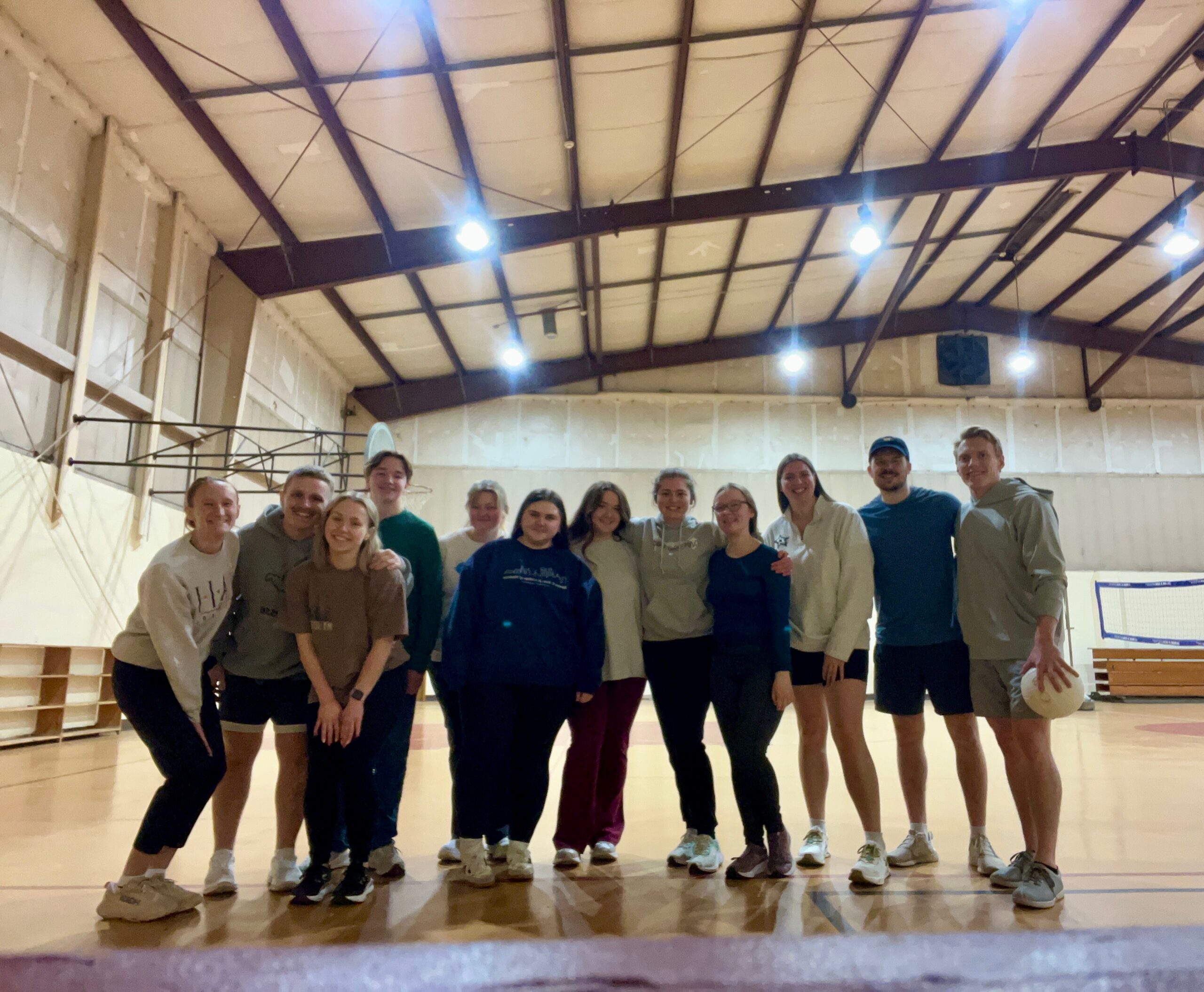
Two weeks ago, Rosedale Baptist in Nashville held a volleyball match at its gymnasium — the first event sparked by the congregants themselves and a sign of the church’s revitalization efforts. – Submitted photo
With Woodmont Baptist’s help, Rosedale is blooming again
NASHVILLE — The bells once tolled for Rosedale Baptist Church.
In its 85th year, the historic church located in Berry Hill, dwindled down to eight faithful members. It seemed destined to fade into the yellowing pages of history.
Today, those same bells ring with renewed purpose. On any given Sunday, 15 to 25 people gather to worship — many of them young families — drawn by expository teaching, fellowship, and a simple mission to keep “the main thing the main thing.”
“I just thought Mom and Dad are looking down and so happy,” said Donna Youree, whose father, Everett Hooper, pastored Rosedale from 1968 to 1990. Hooper passed away in 2012 at the age of 92.
Youree, a 25-year member of Woodmont Baptist Church in Green Hills, still calls Rosedale her home church. When she heard of Woodmont’s replanting effort last year, she was thrilled.
She remembered her father’s missionary-like ministry to blue-collar families, their youth choir, and pews filled with more than 200 people on Sundays in the 1980s.
“At Daddy’s funeral, we could hardly get everybody in because of the young people who grew up in that church,” she said.
“It was just truly a church that ministered to that community. And daddy was, I would say, more like a missionary.”
After Hooper left, Rosedale slowly declined as young families moved away and fellowship waned. By late 2024, the pastor of Rosedale was retiring and the congregation faced extinction.
That’s when Nik Lingle, pastor at Westwood Baptist Church and church revitalization specialist for the Nashville Baptist Association, approached Nathan Parker, who’s been pastor of Woodmont Baptist since 2017, about a partnership.
The plan came together through a network of pastors. They needed someone to lead the revitalization who had experience, vision, and a heart for dying churches.
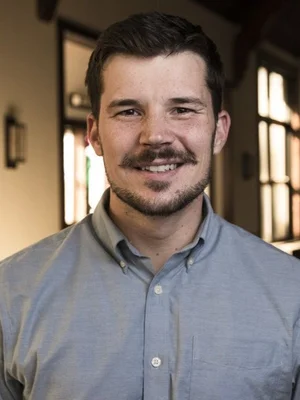
Adam Wheaton – Rosedale Baptist photo
Through that network came Adam Wheaton, a New York native who previously served in a church plant in Chicago. He arrived six months ago as Rosedale’s new pastor.
“Everywhere I’ve been, I’ve seen these little churches dying,” Wheaton said. “And I’ve always kind of had a heart for these churches and had the desire to see the Lord continue working them because I don’t believe the Lord is done working in little churches like Rosedale.”
Wheaton is part of a growing movement among younger pastors who reject the megachurch model in favor of smaller, healthier congregations focused on community and biblical teaching.
“There’s been a big shift,” explained Parker. “The ‘80’s and ‘90’s, it was all about individual church growth. Now you’re seeing a bunch of young guys like Adam and other young pastors that don’t want the megachurch. They want a smaller, healthy church that will grow.”
It’s a shift that aligns with emerging trends among Millennials and Gen Z, some of whom are gravitating toward traditional churches with expository teaching and genuine fellowship.
According to a recent Lifeway study, religious affiliation among 24- to 34-year-olds has remained “remarkably steady” over the past five years after years of increasing secularization. For example, among 24-34-year-olds, 3% converted to Christianity, 31% left Christianity, 42% remain Christian, and 23% have never been Christian.
“We are not able to put on a flashy program or an extensively elaborate service in any way,” said Wheaton. “It’s let’s sing some songs, play the piano, and explore God’s word together. It keeps the main thing the main thing.”
The revitalization has received crucial on-the-ground support from Eddie Chisholm, a Woodmont deacon who has been with the church since 2003 and lives next door to Rosedale. He’s been encouraging neighbors to attend, helping bridge the gap between the two congregations.
“He just knows all of them and he’s got such a heart for people and they love him,” Youree said.
Chisholm’s own journey illustrates why he’s passionate about thriving churches. When he first attended Woodmont years ago, he was struggling with addiction.
“When I first got into recovery, I wasn’t even clean. I was still out there in the addiction field and just finding that this church welcomed me and that they loved me for who I was,” said Chisholm. He now leads Woodmont’s Celebrate Recovery program.
“So I think a healthy church reaches out to those and embrace them into the love of the Lord,” Chisholm added.
For Parker, healthy churches share key characteristics: biblical governance rooted in Scripture, outreach to the community, and a kingdom mindset that values collaboration over competition.
“We had several churches that were closing or close to death,” Parker said. “And it’s not just that we want to preserve those footprints for the legacy of that church, but we want to have healthy gospel outposts on every corner of this town to work together to see the Lord continue to work in this city.”
Wheaton said church revitalization is important because, in short, “it glorifies God.”
Back at Rosedale, Youree sees the echoes of her father’s ministry in the church’s revival.
“Rosedale’s always been an eating church,” she said. “I mean, we fellowship so much. And that’s what they’re doing again, because that’s what they remember. I just think God has sent the right little couple to help them.”
Two weeks ago, Rosedale held a volleyball match at its gymnasium — the first event sparked by the congregants themselves.
“It’s kind of a joy for me as a pastor to be able to really equip the saints for ministry and just equip them to do the thing they want to do,” said Wheaton, adding that they hope to utilize their gym for more community events in the coming year.
Woodmont has a history of planting churches in the Nashville-area, such as Forest Hills (1960) and Brentwood Baptist (1969). The church has also partnered with the Tennessee Baptist Mission Board to launch a Swahili congregation in Nashville.
“I think partnering with established churches and healthy kingdom-minded networks is so important that you don’t have to be a lone ranger. You can’t be a lone ranger,” said Parker. “And that there are good resources now in place that there weren’t back then.”
Lewis McMullen, multiplying healthy churches team leader for the Tennessee Baptist Mission Board (TBMB), said a church replant carries the same spirit as a new church plant.
“Just as every new church needs a mother church to help bring it into being, a replant depends on the loving guidance of a sending church to help bring renewal and rebirth,” McMullen said. “Your church’s impact is not measured by its age, but by its heart to be mission minded and its courage to plant or replant where God opens doors.”
While the TBMB and local associations don’t plant or replant churches directly, McMullen said they gladly walk beside those who do. The TBMB also provides financial support to help Woodmont with the replanting efforts.
“Our role is to equip, resource, train, and help assess needs so that every replant can thrive and once again become a living witness to the gospel in its community,” McMullen said.
“I’m really grateful to partner with the TBMB to be able to work together to see kingdom-minded partnerships,” said Parker.
Wheaton acknowledges the challenge ahead. Nashville’s rapid population growth demands more churches, not fewer, he said. The task can seem overwhelming.
“It almost seems like we realize there’s a tidal wave and we’re not ready for it. It makes the task seem as big as it really is,” said Wheaton. But he thinks there’s some good leadership in the city that is committed to partnership to combat this tidal wave.
“The value of partnership is something that we’ve seen in amazing ways,” said Wheaton. “In Nashville as a whole, it’s something that I’ve never seen before — the way churches are committed to the kingdom, not to their individual groups growing, but to the kingdom actually growing here in Nashville.”
Now with further growth and a bright future, the bells toll for Rosedale with the song of hope to spread the gospel and not to remain confined to the pages of history. B&R