EDITOR’S NOTE: This story has been updated.
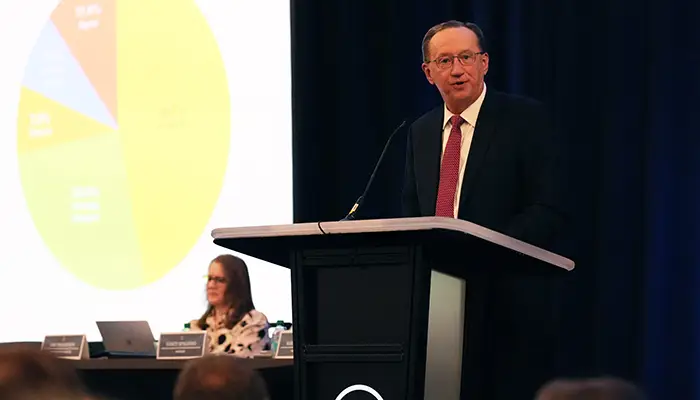
SBC Executive Committee President Jeff Iorg presents a recent survey detailing pastor’s thoughts on the Cooperative Program to the EC Feb. 16 in Nashville. More than 5,000 Southern Baptist pastors shared feedback in the Dec. 2025 survey. – BP photo by Brandon Porter
NASHVILLE (BP) – Southern Baptist pastors enthusiastically support the Cooperative Program (CP), according to a survey released at the SBC Executive Committee’s Feb. 16-17 meeting in Nashville. But they also see opportunity for better CP vision casting to rising generations
Ninety-one percent of pastors either agree or strongly agree that CP “helps churches accomplish more together than they could alone.” More than 87 percent agree or strongly agree that their church views CP “as a trustworthy way to support missions.”
Most pastors have no plans to withdraw their churches’ support of CP, Southern Baptists’ unified program for funding missions and ministries at home and across the globe.
Nearly three-quarters (74 percent) of respondents disagree or strongly disagree with the statement, “My church has reduced CP giving due to lack of confidence in the SBC.” A similar number (72 percent) disagree or strongly disagree that their church “is considering decreasing Cooperative Program giving.”
“Chicken Little is incorrect. The sky is not falling,” said Texas pastor Caleb Turner, a member of the advisory group that created the survey. “Things are much better than what social media would have you believe. There is a very vocal minority, but overwhelmingly pastors are invested in the Cooperative Program.”
At the same time, “there is room for teaching, training and understanding what the Cooperative Program is about,” said Turner, pastor of Dallas-area Mesquite Friendship Baptist Church.
The survey was conducted by the Executive Committee via email Dec. 2-11, 2025, and received 5,186 responses. The advisory group comprised pastors, state convention leaders, national entity leaders and ethnic fellowship leaders.
Advisory group leader Brandon Porter, EC vice president for communications, said the survey “was emailed to more than 45,000 Southern Baptist pastors.” The group was “very pleased to receive responses from more than 10 percent of the recipients.”
Among other results:
- 81 percent of pastors agree that they have “personally seen positive results from ministries funded through the Cooperative Program.”
- 82 percent agree that CP “promotes unity among Southern Baptists.”
- 73 percent agree that CP “is our church’s preferred method of missions giving.”
- 83 percent agree that “a decline in CP participation would hurt missions and ministry effectiveness.”
- A slight majority (52 percent) disagrees that “conflict or mistrust in SBC leadership has affected my church’s confidence in giving through CP.” Thirty-eight percent agreed or strongly agreed with that statement while almost 11 percent of respondents were unsure.
“Pastors are overwhelmingly positive about the Cooperative Program,” EC President Jeff Iorg said as he unveiled the survey data in his report to the Executive Committee. He added that “there were also some negative comments, but they were not nearly as prevalent as social media might lead us to believe.”
Pastors’ responses to open-ended questions seemed to confirm their responses to the agree-or-disagree statements.
“Participants regularly pointed to how cooperation enables stronger work in missions, church planting, theological education and disaster relief,” according to a response summary in the survey findings. Respondents also said CP “provides an opportunity for a smaller church to be a part of the larger mission.”
Along with the positive news, the survey revealed opportunities to improve CP. Respondents are unsure whether their churches will increase CP giving in the future and whether younger pastors will catch the vision of CP.
- 33 percent of pastors are unsure whether CP is perceived as “less relevant” by their younger pastoral colleagues.
- 24 percent are unsure whether “designated giving diminishes the impact of the Cooperative Program.”
- 28 percent are unsure whether “churches are becoming less willing to cooperate financially for shared goals.”
- 30 percent are unsure whether their church is open to increasing CP giving.
“These high unsure responses reveal places for training, advocacy and education,” Iorg said. “All of this tells us that Convention leaders and influential pastors must make the case for cooperative giving, including providing resources and rationale for these decisions. We have continued work to do in promoting and managing the Cooperative Program.”
As with the more positive data, free responses confirmed survey responses related to weaknesses, opportunities and threats.
“Many participants” felt “disconnected,” “voiceless” or underrepresented “when it came to decisions or learning about ministry results,” the survey findings stated. Some respondents “called for the start of a new century of the Cooperative Program to be a time when the initiative’s vision was clarified and shared.”
Among the 59 percent of pastors who responded to an open-ended question on threats to CP, the words “transparency” and “trust” were mentioned most often. “Transparency” appeared in 9 percent of those responses. “Mistrust,” “distrust” or “trust” appeared in 8 percent.
The economy also was cited as a threat to CP, which may help explain why total CP giving from churches has declined by more than $50 million annually over the past two decades despite the perseverance of enthusiasm for the Cooperative Program.
A separate Lifeway Research survey released last fall found half of U.S. Protestant pastors (49 percent) say the economy is negatively impacting their churches. Some hope for economic improvement emerged from the Evangelical Council for Financial Accountability’s 2025 State of Giving report, which found a 2.6 percent increase in cash giving to churches from 2024-25.
Now that the CP survey data is in, the EC says it will begin developing educational and promotional resources based on the results.
That’s not to say CP promotion to date has been ineffective. Sixty-three percent of Southern Baptist pastors agree that most members of their churches understand what CP is. Seventy percent agree their church “clearly communicates how CP funds are used.”
Still, 69 percent of pastors agree that “better storytelling (videos, testimonies, local impact) would help strengthen support for CP.” Fifty-seven percent agree that more frequent reporting about CP results increases their church’s enthusiasm for giving.
“The survey helps us understand the need for greater Cooperative Program education,” Porter said. “We will begin working with our state convention partners to develop strategies and resources to help Southern Baptists understand the value of the Cooperative Program and how it works. When pastors learn about the reach and the efficiency of the Cooperative Program, they are blown away and want to get involved.”